Creatine: Fact or Fiction
Introduction
Welcome back to another edition of Fact or Fiction, where I take today’s biggest wellness topics and put them under the microscope to see if they’re actually worth adding to your routine, or better left on the shelf. By translating the latest research into clear, digestible insights, I help you separate real science from the B.S.—no B.S. required.
If you clicked on this article, you’ve probably heard of creatine. It is everywhere right now, especially in the fitness world, where it’s marketed as a fast-acting performance booster with brands claiming to show results in as little as one to four weeks. Sounds too good to be true, right? Well, let’s take a look at the science as we discover whether creatine is fact or fiction.
What does creatine do?
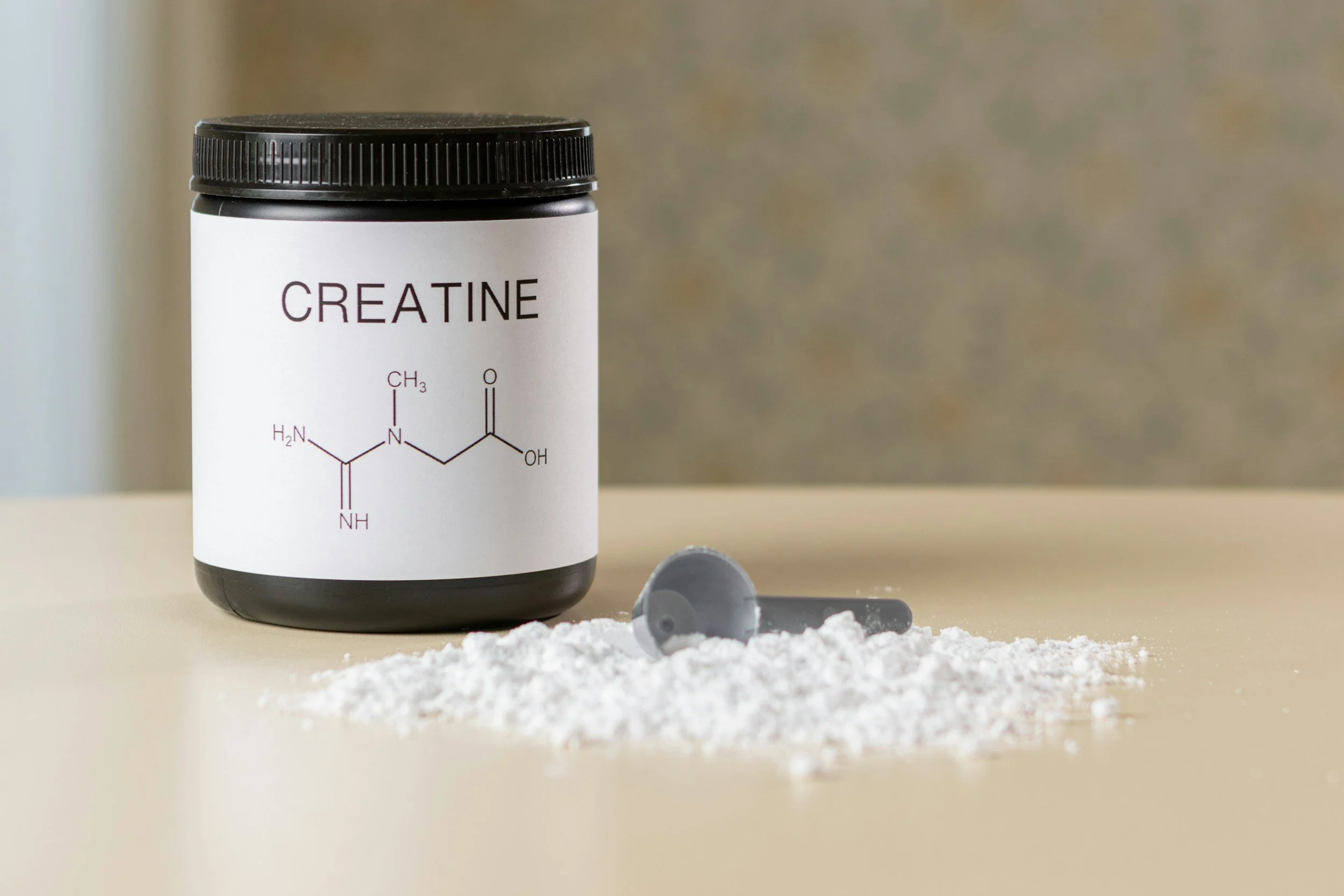
Creatine is a derivative of amino acids, and it is naturally produced in the body from eating animal-based foods such as red meat, fish, and poultry. It plays a large role in the fast energy recycling system. ATP is the body’s energy source that is used to carry out physical activity. When the muscles are performing intense activities, such as lifting heavy weights, they use up ATP relatively quickly. The muscles require fast energy to carry out short bursts of high-intensity exercise. This is where creatine comes into play.
Creatine kinase (CK), makes creatine give up its phosphate molecule and give it to another substance called ADP. When ADP receives the phosphate molecule, it converts into its active form, ATP. This provides your muscles with those quick bursts of energy to carry out high-intensity workouts or sports.
Strength and Athletic Performance
The earliest and most extensive body of creatine research centers on its role in athletic performance. Supplementation consistently increases muscle creatine and phosphocreatine (PCr) levels, allowing for faster regeneration of ATP. This translates into improved performance during short, high-intensity efforts such as weightlifting, sprinting, swimming, soccer, hockey, and many other sports. When looking at dozens of experiments, performance improvements of 10–20% have been reported in high-intensity exercise tasks.
Because of the overwhelming consistency of the evidence, the International Society of Sports Nutrition has labeled creatine as the most effective ergogenic nutritional supplement available for increasing high-intensity exercise capacity and muscle.
Brain Health
The brain is one of the most energy-demanding organs in the body, relying on a constant supply of ATP to think, focus, and respond quickly. Research shows that creatine supplementation can raise brain phosphocreatine (PCr) levels by 5–15%, directly strengthening the brain’s energy reserves. Because of this, scientists have taken a serious interest in how creatine affects mental fatigue, memory, executive function, and processing speed.
The results are compelling. Studies show that supplementing 8 gm/day increased oxygen utilization in the brain and reduced mental fatigue in participants performing repetitive mathematical calculations. Consider having your creatine with your coffee because the next study proves that it can boost cognitive function in sleep-deprived participants. When supplementing 20gm/day for 7 days, sleep-deprived subjects displayed faster reaction time, improved mood, improved balance, and maintained movement generation. While more research is needed and not all studies conclude in a benefit; it can be reasonably concluded that supplementation may support cognitive function, especially with age.
Studies consistently show that creatine can reduce mental fatigue, sharpen working memory, and improve reaction time, especially during high-stress situations like sleep deprivation or intense mental effort. These cognitive benefits are likely driven by creatine’s role in stabilizing ATP production in neurons, helping the brain stay energized when it’s under pressure.
Blood Sugar Control
As my readers know, blood sugar control and insulin sensitivity are among my favorite topics to discuss here at Plateau. Interestingly enough, emerging research suggests that creatine plays a meaningful role in glucose metabolism. When taking 5gm/day for 12 weeks, participants with type 2 diabetes experienced creatine absorption into the muscle cells. The uptake of creatine into the muscles is influenced by insulin, similarly to how glucose uptake into the muscles is controlled by insulin as well.
Participants with type 2 diabetes also experienced improved glucose tolerance, meaning their bodies were better able to handle carbohydrates and sugars with less extreme rises in blood glucose compared to before. Creatine supplementation caused a decrease in HbA1c levels in the participants with type 2 diabetes as well.
Overall, creatine may support better long-term glycemic control, especially when paired with physical activity. This positions creatine as a promising nutritional tool in diabetes management, not as a replacement for medication, but as a complementary metabolic support.
Muscle Loss Prevention in Older Adults
As we age, natural declines in muscle mass, strength, and balance may occur, often leading to frailty, falls, and loss of independence. One of the most significant age-related conditions is sarcopenia. Sarcopenia is unintended muscle loss in older adults that can lead to fractures, falls, insulin resistance, and longer hospital stays. Research consistently shows that creatine, when combined with resistance training, significantly enhances gains in lean muscle mass and strength in adults over 60.
There was a study done on creatine supplementation of 5gm/day for 14 weeks in men and women 65 years and older. Combined with heavy resistance training, these men and women saw a greater increase in muscle mass. A separate study found that when older, vulnerable women took creatine while doing resistance training, they gained more muscle mass and had better muscle function. They saw increased muscle mass in their arms and legs. The women who took creatine without exercising still gained nearly as much muscle as those who exercised without creatine. Similarly, another study showed that older women who took 5 gm/day of creatine a day while strength training for 12 weeks improved their muscle endurance, strength, ability to perform daily tasks, and overall muscle mass.
Creatine also appears to protect muscle during periods of weight loss and calorie restriction. Many older adults develop adult-onset obesity and attempt calorie restriction, which often leads to muscle loss. As we know, muscle loss leads to rapid physical decline in older adults. Creatine supplementation during energy-restricted diets has been shown to preserve lean mass while simultaneously supporting fat loss, making it a valuable tool for managing obesity without accelerating physical decline. Moreover, studies in older men and women demonstrate improvements in upper and lower body strength, muscle endurance, balance, bone density, and functional capacity when creatine is combined with structured exercise
FACT or FICTION
Creatine is …. FACT. Creatine has been studied for decades and used by millions of people, and the science is very clear; it is safe and effective. With benefits in muscle growth, cognitive performance, insulin sensitivity, and aging, creatine is a powerhouse supplement that should be added to any weight-lifter’s wellness routine.
Creatine will falsely elevate creatinine lab values, which are a marker of kidney function. The concern for creatine supplementation on long-term kidney health is valid, but put your fears to rest, because the science says it’s safe. Researchers have conducted over 680 human studies involving more than 26,000 participants across a wide range of ages, with some studies tracking supplementation for up to 14 years. Collectively, these findings consistently show that creatine does not increase the risk of serious adverse effects. The authors of this comprehensive analysis, led by Kreider et al., conclude that creatine supplementation poses no risk to kidney function in healthy or medically managed individuals.
Despite this strong safety record, misinformation online and on social media still causes confusion and fear. In reality, major health and sports organizations agree that creatine monohydrate is safe for long-term use, and limiting access to it could actually do more harm than good for public health. Creatine is Plateau approved for men, women, athletes, and the elderly. Just make sure to combine creatine with some form of resistance training and increase your water intake.
Sources:
Kreider RB, Stout JR. Creatine in Health and Disease. Nutrients. 2021 Jan 29;13(2):447. doi: 10.3390/nu13020447. PMID: 33572884; PMCID: PMC7910963.
Kreider, Richard B, et al. “Safety of Creatine Supplementation: Analysis of the Prevalence of Reported Side Effects in Clinical Trials and Adverse Event Reports.” Journal of the International Society of Sports Nutrition, vol. 22, no. sup1, 8 Apr. 2025, https://doi.org/10.1080/15502783.2025.2488937.